
Most business email compromise attacks succeed not because staff miss obvious signs, but because the emails look exactly like normal business requests. Training alone cannot stop what appears completely routine.
A fraudulent transfer rarely starts with an obvious red flag. It starts with an email that reads exactly like every other request a business receives that week, which is precisely why business email compromise does so much damage before anyone notices.
Losing money to business email compromise is more than an IT problem—it can stop payments, disrupt operations, and damage trust with suppliers and clients. Once a fraudulent transfer goes through, the impact can ripple across the entire organisation.
Given that, many businesses assume training staff to spot suspicious emails is enough to prevent these attacks. Yet the most damaging messages often look completely ordinary, and that's precisely the problem: a convincing email can slip past even the most attentive employee without raising a single flag.
Business email compromise (BEC) is a type of cyber attack where criminals use social engineering techniques to trick staff into transferring funds or sharing sensitive information. To pull this off, attackers often impersonate trusted contacts, making their requests appear routine and legitimate rather than suspicious.
So while awareness training has real value, leaning on it as the main defence leaves a gap that sophisticated attackers know exactly how to exploit.

Why ordinary emails are the real threat
Most people expect a scam to look suspicious—maybe a strange sender address or an urgent tone. BEC attacks work differently: they're designed to blend in. Attackers study the organisation, learn how the team communicates, and mimic those patterns closely.
Rather than obvious red flags, these emails use familiar language and come from addresses that look correct at a glance. The request might be as simple as asking for an invoice to be paid or updating bank details, and because nothing seems out of place, staff are more likely to act without question.
That blending in is exactly what makes BEC so effective. The attacker doesn't need to trick everyone—just the one person with the authority to approve a payment or share sensitive information. When the email matches what the team expects to see, traditional training falls short at the one moment it matters most.
The limits of awareness training in business email compromise
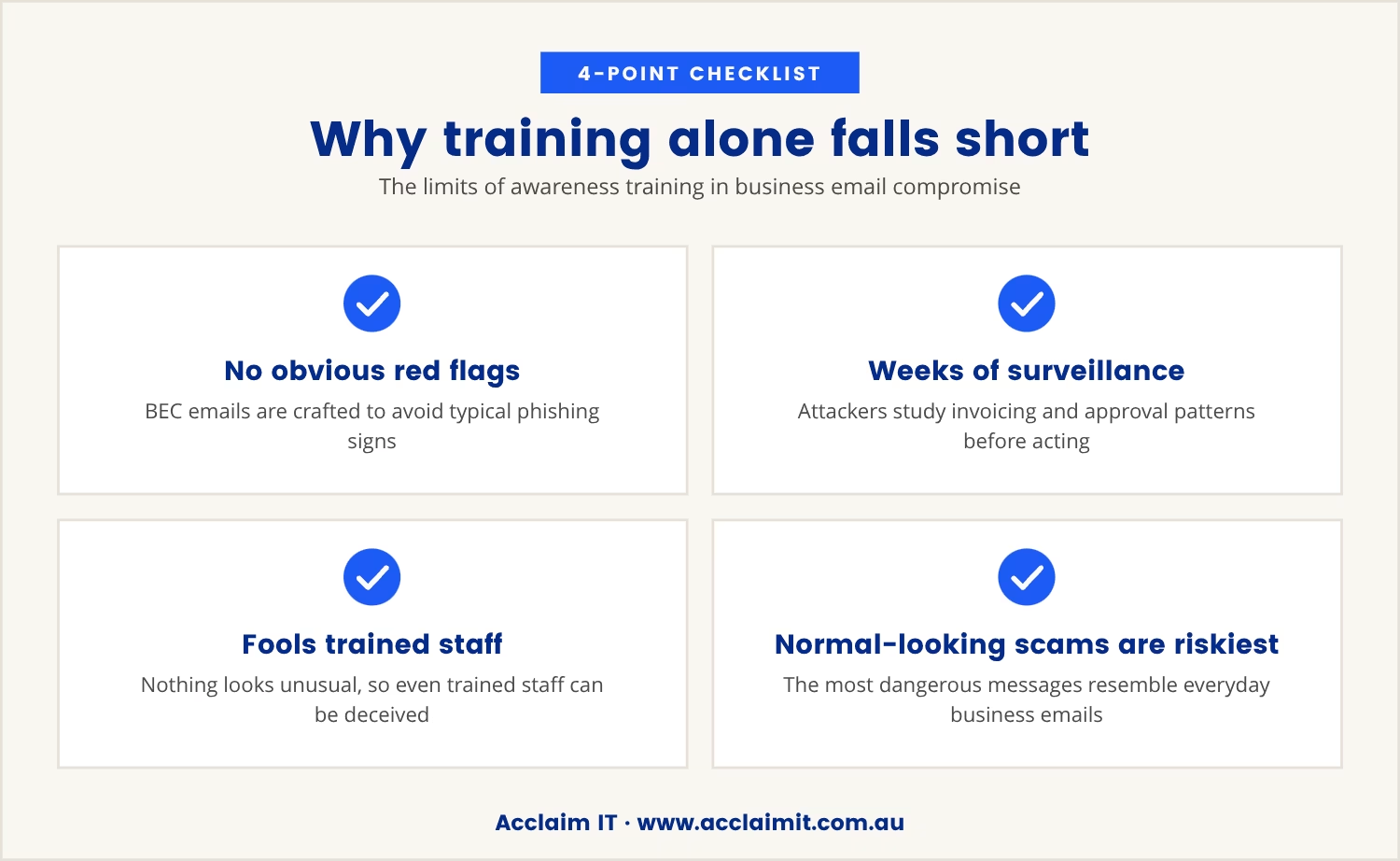
Security awareness training usually focuses on spotting obvious signs of phishing—poor grammar, mismatched URLs, or urgent requests. BEC scams sidestep all of that: these emails are crafted specifically to avoid those signs.
To get there, attackers might spend weeks monitoring an organisation's email traffic, waiting for the perfect moment to strike. They learn when invoices are sent, who approves payments, and how requests are worded, so that when they finally act, their email looks like any other business communication.
Even well-trained staff can be fooled when nothing about the message looks unusual. Training teaches people to look for warning signs, but a well-executed BEC attack may simply have none to find—which is exactly why relying on training alone is risky.
Businesses in Melbourne and beyond need to recognise that the most dangerous scams are the ones that look completely normal. Without additional layers of protection, even the most diligent employee can still be caught off guard.
How BEC attacks bypass traditional email security
Many organisations invest in email security tools that block spam and filter out known threats. These systems catch plenty of malicious content, yet they are not foolproof against BEC attacks.
Unlike malware or standard phishing attempts, BEC emails rarely contain suspicious links or attachments. Instead, they rely on trust and familiarity, and because security filters are built to look for technical indicators of compromise, BEC messages often give them nothing to detect.
Matters get harder still when attackers compromise a real email account within the organisation or a supplier's network. A message sent from a genuine address is far tougher for both staff and automated systems to flag, which is why BEC is considered a form of account compromise as well as social engineering.
On top of that, attackers often time their messages to coincide with busy periods, such as the end of the month or financial year, when staff are more likely to approve requests quickly. Timing, trust and technical evasion combine to make BEC a genuinely unique challenge.

Business email compromise in Melbourne: What local businesses should know
For businesses in Melbourne, the risks around BEC are no different than anywhere else, though local context can shape how a business responds. Many companies here rely on regular supplier payments and fast-moving approvals, and that rhythm is exactly what BEC attackers exploit.
Australian regulations require organisations to protect customer data and report certain types of cyber incidents, but compliance alone does not guarantee protection against BEC. Attackers target process gaps, not just technical weaknesses.
If a business handles frequent wire transfers or works with multiple suppliers, exposure rises accordingly. Have you reviewed your payment approval process recently to see if there are any steps an attacker could exploit?
The anatomy of a BEC attack: How attackers blend in
Seeing how a BEC attack unfolds helps explain why ordinary-looking emails are so dangerous. Here's how attackers typically operate:
Research and reconnaissance
Attackers gather information about the organisation, its suppliers, and its payment processes by scanning public sources and monitoring email traffic.
Compromising an email account
They may use phishing or malware to gain access to a real email account, either within the business or at a supplier.
Crafting a convincing message
With that access and knowledge in hand, they build an email that matches the usual communication style, often copying past requests or reusing familiar phrases.
Timing the attack
Attackers wait for a moment when staff are busy or distracted, such as during holidays or financial deadlines, to increase the chance of success.
Making the request
The email asks for a payment, change of bank details, or sensitive information, appearing to come from a trusted source.
Following up if needed
If the first attempt fails, attackers may send reminders or escalate the request, mimicking normal business follow-up.
Why process matters more than perception
Given how convincingly these emails blend in, stopping BEC scams can't rely on staff perception alone. Processes that require verification of payment requests—such as a phone call to confirm changes in bank details—prove far more effective.
A well-designed process takes the pressure off individual staff to spot every threat, building in checks that attackers cannot easily bypass. Requiring two people to approve any wire transfer over a certain amount, for instance, adds a layer of protection that no amount of training can replace.
These controls need regular review and testing to confirm they're followed even during busy periods. Automation can help by flagging unusual requests or changes, but the process itself remains the foundation everything else sits on.
Practical steps to reduce BEC risk
Awareness training has its place, but it works best as just one part of a broader defence. Here are some practical steps to strengthen protection against BEC:
- Verify payment requests: Always confirm changes to bank details or payment instructions using a method other than email.
- Use multi-factor authentication: Require extra verification for access to sensitive email accounts.
- Limit access: Restrict who can approve or initiate wire transfers within the organisation.
- Monitor for unusual activity: Set up alerts for unexpected login locations or times on key accounts.
- Review supplier relationships: Regularly check that supplier contact details and payment processes are up to date.
Each of these steps closes off a different weakness that BEC attackers might try to exploit, and combined, they form a much stronger defence than training alone.
The real cost of relying on training alone
When a business trusts staff training as its main defence, it risks missing the point of how BEC actually works: the most convincing scams are designed to look like routine business, not obvious threats.
Financial losses from BEC scams now make up more than 44% of all losses associated with cybercrime, showing just how effective these attacks can be.
A single mistake can lead to significant financial and reputational damage, which is exactly why process and technical controls deserve more weight than awareness alone. Training helps, but it cannot replace a system that makes fraud much harder to pull off.

Why process beats perception for real protection
Many businesses with 20 to 100 users trust staff training to keep them safe, but the most convincing BEC scams are built to slip past even the best-trained teams. At Acclaim IT, we understand how easy it is for a routine-looking email to trigger a costly mistake.
If you want to see how we approach BEC risk beyond awareness training, or want to talk about your own approval processes, our team is ready to help.
Ready to close the gaps BEC attackers exploit?
Get your onboarding fees waived and a 90-day satisfaction guarantee when you qualify for our support—so you can strengthen your defences with less risk.
Frequently asked questions
What makes a BEC scam different from typical phishing?
A BEC scam is more targeted and convincing than standard phishing. Rather than sending generic messages to many people, attackers research the organisation and craft emails that look like normal business requests, often impersonating trusted contacts while avoiding the obvious signs of fraud.
How can we improve our email security without relying only on staff vigilance?
Email security strengthens with technical controls like multi-factor authentication, limits on who can approve payments, and monitoring tools that detect unusual account activity. These measures reduce the risk that a single mistake leads to a successful attack.
Are certain types of business email compromise more common in medium-sized businesses?
Medium-sized businesses often process many payments with less complex approval processes than larger organisations, making them attractive targets for BEC. Attackers may focus on invoice fraud or supplier impersonation, where routine requests are more likely to be approved quickly.
What should we do if we suspect a compromise attack has occurred?
Acting quickly matters most: stop any pending payments, alert the bank, and contact the IT team to secure affected accounts. Review recent email activity and inform any suppliers or clients who may be involved.
How do cybercriminals choose which organisations to target?
Cybercriminals often look for organisations with predictable payment processes, frequent wire transfers, or public information about staff roles. They may also target businesses that appear to have less advanced cyber security controls or that work with multiple suppliers.