
Investing in fast technical recovery is wasted if you haven’t first mapped your business processes to recovery priorities. Technology alone can’t decide what matters most—your plan must come first.
It's widely assumed that disaster recovery vs business continuity is a contest won by whoever buys the fastest technology. In practice, speed means little without a clear view of which business functions need to come back first.
A single insight changes how you see this: technology that restores systems quickly is only valuable if you've already decided which business areas matter most.
That gap shows up in the numbers. One survey found that 78% of organisations have experienced an outage, yet not every outage affects all business functions equally.
This is why disaster recovery and business continuity, though often lumped together, serve different purposes. Disaster recovery is about restoring IT systems after a disruption; business continuity is about keeping essential operations running no matter what happens around them. Knowing the difference is what makes a recovery investment count rather than simply exist on paper.

Mapping recovery priorities: The step many businesses skip
It's tempting to assume every system and process deserves equal protection, but that assumption doesn't survive contact with reality. Some functions can sit offline for hours or days without serious harm, while others must be back within minutes or the losses start compounding.
Skip the step of ranking what matters, and money gets spent recovering the wrong things fast. Restoring a non-essential file server in seconds does nothing if the customer service platform stays down for hours instead. The outcome is wasted spend sitting alongside missed chances to protect what actually mattered.
A business impact analysis is the tool that sorts essential functions from those that can wait, and from that ranking comes a recovery time objective for each one. Set that way, spending on recovery technology tracks what the business actually needs rather than what looks impressive on a spec sheet.
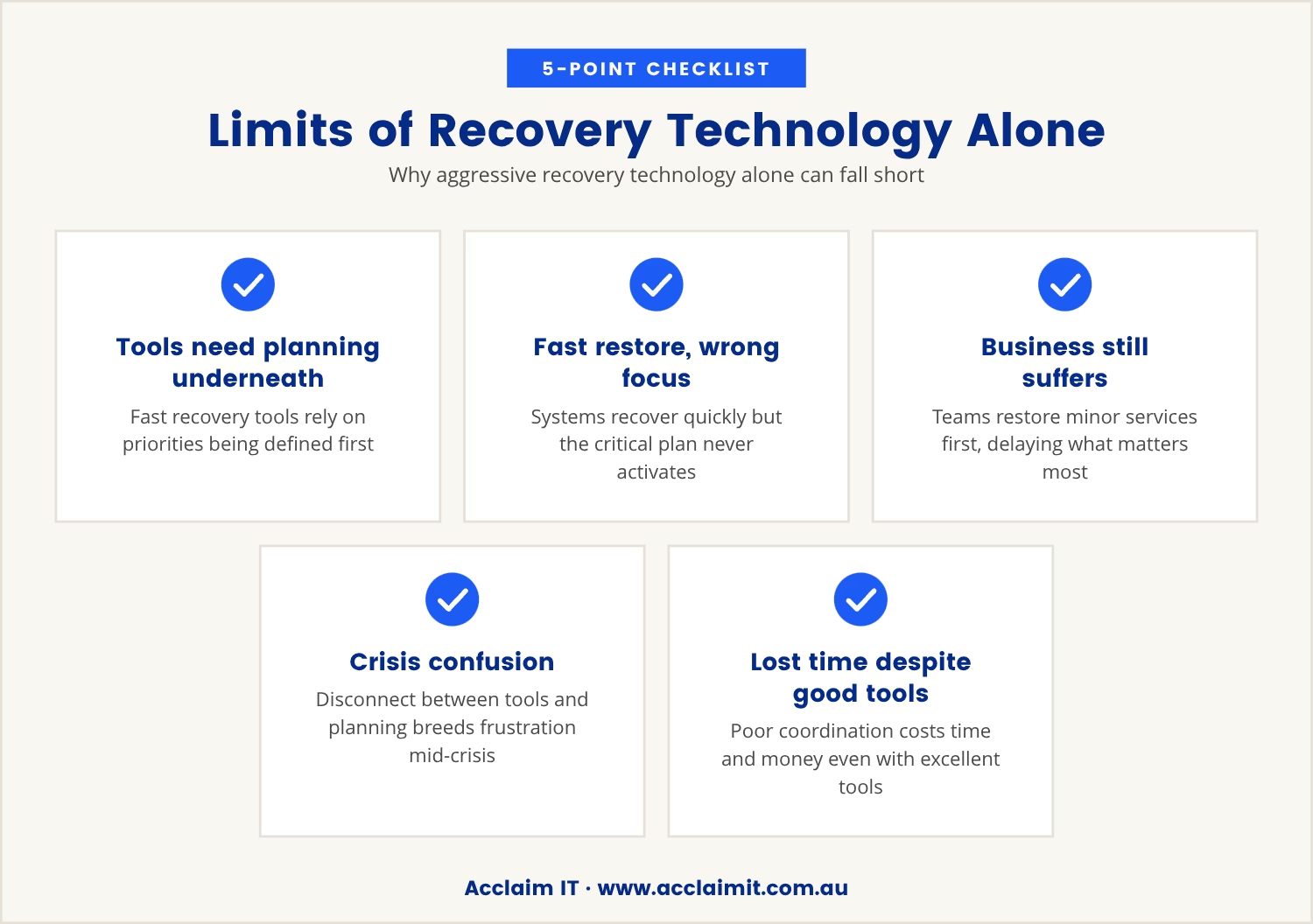
Why aggressive recovery technology alone can fall short
Plenty of organisations assume the newest disaster recovery plan or backup system will cover every contingency on its own. Yet fast recovery tools are only as good as the planning that sits underneath them, and no technology can decide your priorities for you if you haven't defined them first.
Picture every system restored at top speed, only for the most important business continuity plan to never get activated at all. The technology did its job perfectly; the business still suffers, because without a clear plan teams scramble to bring back less important services first and delay what actually needed attention.
That disconnect tends to surface as frustration and confusion right in the middle of a crisis. Teams don't know which systems to chase or how to coordinate the effort, and the result is lost time and lost money even when the tools themselves are excellent.
Disaster recovery vs business continuity: What Melbourne businesses need to know
For businesses in Melbourne, understanding the difference between disaster recovery and business continuity isn't a technical nicety—it's a practical necessity. Disaster recovery handles the technical side: servers, data, systems coming back online. Business continuity is broader, covering how the whole operation keeps moving, including people, processes, and communications.
Invest in disaster recovery without a continuity plan sitting alongside it, and the bigger picture slips away. IT systems might come back online within minutes, yet if staff don't know the process for handling customer calls during the outage, service still suffers regardless. The two approaches need each other, and the priorities driving both should come from business needs rather than from what the technology happens to make easy.
Melbourne businesses carry an added layer here too: local risks such as power outages or natural disasters, which can disrupt IT and non-IT functions in the same stroke. Mapping recovery priorities first is what makes sure the investment protects the areas that matter most to the operation, rather than whatever was simplest to automate.
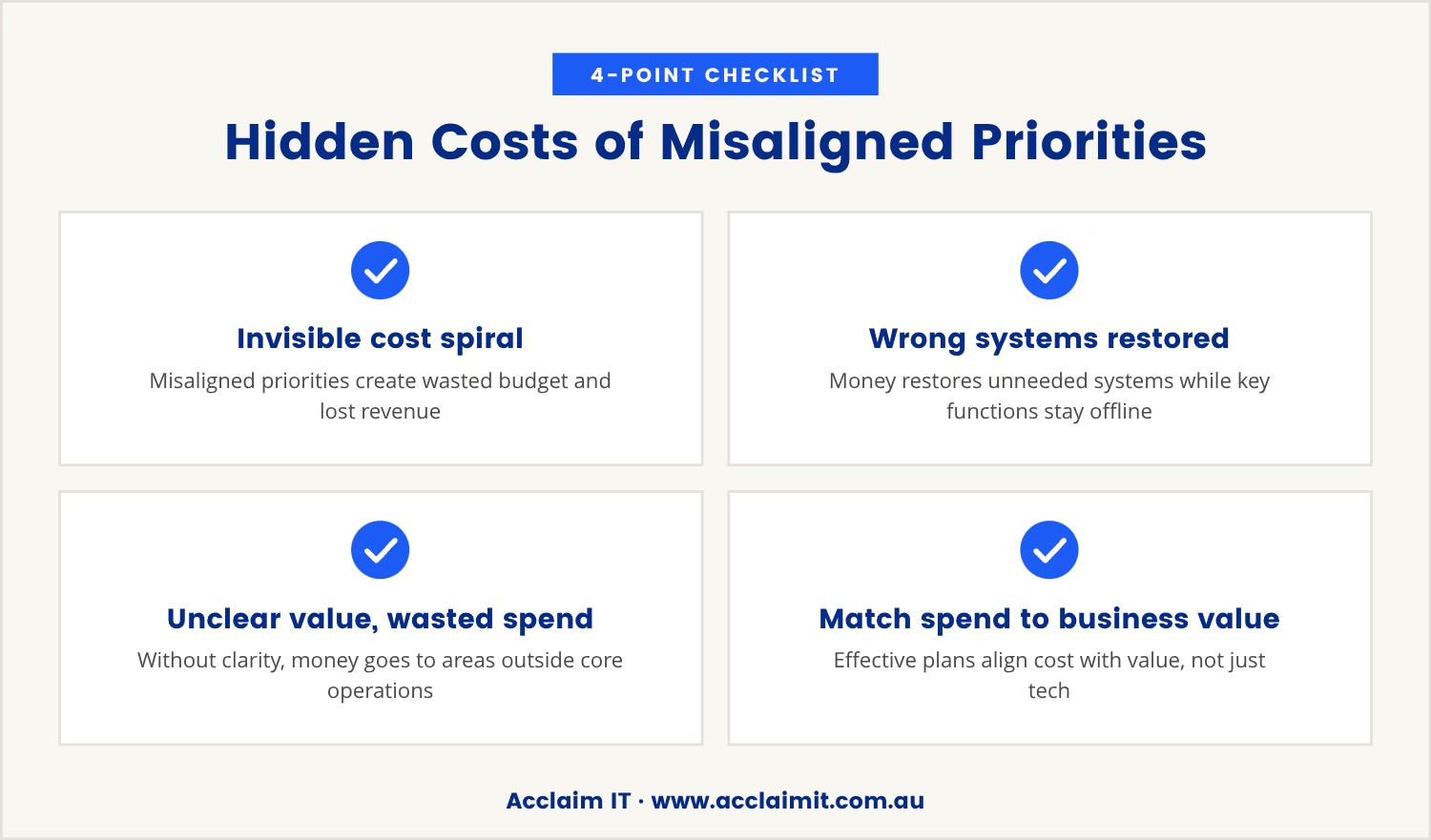
The hidden costs of misaligned recovery priorities
When recovery priorities aren't mapped to business needs, costs spiral quickly and often invisibly. Thousands can go toward restoring systems nobody urgently needs while the functions that actually matter sit offline, and that misalignment shows up later as wasted budget and lost revenue.
There's a related risk of overprotecting low-value assets. As one industry figure puts it, there's no use in spending US$200 to protect US$5. Without a clear read on what's genuinely valuable, businesses end up pouring money into areas that don't support core operations at all.
The most effective recovery plans match spending to business value rather than to technical capability. Aligned that way, technology investment stops creating unnecessary cost and starts making sure the business bounces back exactly where it counts.
What a business impact analysis actually delivers
A business impact analysis (BIA) is more than a checklist—it's the foundation smart recovery planning is built on. Here's what a well-run BIA brings to a business:
Identifies critical business functions
A BIA pinpoints which operations are essential to keeping the business running, so recovery effort goes where it matters most.
Sets recovery time objectives
It defines how quickly each function must be restored, which makes realistic targets possible instead of overcommitted resources.
Reveals process dependencies
The analysis uncovers which systems and teams rely on each other, so recovery can be coordinated rather than patched together in isolated fixes.
Guides technology investments
Clear priorities mean spending goes on tools that support the most important functions, not just whatever has the newest features.
Supports compliance and risk management
A thorough BIA helps meet regulatory requirements and manage risk more effectively, cutting the chance of costly surprises later.
Improves communication during a crisis
When everyone knows the plan and their role in it, the team acts quickly and confidently instead of losing time to confusion.
Signs your recovery plan is missing the mark
A recovery plan that isn't mapped to business priorities tends to reveal itself in smaller, subtler signs first. Watch for these:
- Unclear priorities: teams aren't sure which systems or processes to restore first during an incident.
- Overbuilt solutions: high-speed recovery has gone into areas that rarely affect the core business.
- Confused communication: staff get mixed messages about what to do when disaster strikes.
- Missed compliance targets: regulatory requirements get overlooked because priorities were never clearly defined.
- Budget overruns: spending grows with no clear link to business value or outcomes.
If several of these sound familiar, it's worth revisiting how the recovery plan lines up with business continuity management.
Bringing IT and business together for real resilience
Building real business resilience means connecting the IT recovery plan with the business continuity plan, and that's about more than having both documents on file—it's about making sure they actually work together.
That starts with IT and business leaders planning side by side. Which business functions can your operation not afford to lose, even for a short stretch? The answer should drive recovery priorities, not the other way around, and never just the capabilities the technology happens to offer.
When IT and business teams share the same view of what matters most, recovery effort gets targeted instead of scattered. Less gets wasted, and the business keeps serving customers even while the crisis is still unfolding.
The bottom line: Prioritise process before speed
Fast recovery technology is only as valuable as the plan sitting behind it. Skip the step of mapping business processes to recovery priorities, and money gets spent without protecting what actually matters. The smartest investment starts with business needs and builds the technology around them, not the reverse.

How Acclaim IT helps you align recovery with real business needs
Many businesses with 20 to 100 users find themselves relying on fast recovery tools, only to realise their processes were never mapped to real priorities. At Acclaim IT, we see this gap often and know how it can leave critical functions unprotected.
If you want to see how our team approaches recovery planning that actually fits your business, we invite you to start a conversation about your current setup and what matters most to your operation.
Ready to align your recovery spend with real priorities?
Get onboarding fees waived and a 90-day satisfaction guarantee when you qualify as a new client—so you can see the value of a tailored recovery plan with no upfront risk.
Frequently asked questions
How do I decide which business functions are most critical for recovery?
Start by conducting a business impact analysis, which identifies which operations are essential for survival and which can be delayed. Involve leaders from different departments so the dependencies and priorities reflect the full picture, not just one team's view.
What's the difference between a business continuity plan and a disaster recovery plan?
A business continuity plan focuses on keeping core business operations running during and after a disruption, covering people, processes and communication. A disaster recovery plan is more technical, dealing with how IT systems and data get restored after an incident, and both play distinct, necessary roles.
Can I use the same recovery plan for all types of disasters?
Some steps overlap, but cyberattacks, natural disasters and power outages each affect a business in different ways. A plan needs enough flexibility to cover a range of scenarios while still prioritising the most critical business functions first.
How often should I review my business continuity and disaster recovery plans?
Review plans at least once a year, or whenever major changes occur in the business, such as new systems, processes or regulations. Regular testing and updates keep plans relevant rather than letting them quietly go stale.
What role does risk management play in business continuity?
Risk management identifies potential threats to a business and assesses their likely impact. Understanding those risks is what allows a business continuity plan to address the most likely and most damaging scenarios, keeping recovery effort focused rather than spread thin.