The real difference between ISO 27001 and NIST for a growing business lies in five decision points that go beyond technical controls. Focusing on purpose, audience, cost, audit burden, and maintenance prevents you from being locked into a framework that doesn’t fit your size or needs.
Picture a Melbourne business with 20 to 100 users that has just won a tender on the condition it proves its security credentials within ninety days—and now has to choose a framework under pressure.
That choice sets the pattern for years, because whichever way it leans, the operational habits built in that first quarter tend to stick. The decision looks small at the outset, almost administrative, but it determines how security and compliance get handled long after the deadline has passed. Growing businesses facing this fork quickly discover that ISO 27001 vs NIST is not a contest of checklists or acronyms.
Both frameworks are respected, yet each suits a different kind of operation, and the split between them shows up less in the controls themselves—which overlap considerably—than in the obligations and future work each one creates. ISO 27001 is a certifiable standard; NIST is a flexible framework without certification. That single distinction changes how compliance gets demonstrated to partners and regulators, and it's worth working through before committing either way, since the right choice avoids locking a growing business into a system built for one much larger or more heavily regulated.

Why the purpose behind your framework matters
Purpose is where ISO 27001 and NIST first diverge. ISO 27001 sets out an information security management system (ISMS) built to be certified; NIST, particularly the NIST Cybersecurity Framework (CSF), offers guidelines for strengthening security posture without any certification step at the end.
That root difference carries straight through to daily use. ISO 27001 means building a system that can be audited and certified — often exactly what's needed when clients or partners demand documented proof of compliance. NIST instead hands over a toolkit for measuring and improving controls, useful but never certificate-bearing.
So the question becomes what kind of proof the business actually needs. Where external proof matters — a certificate to point to — ISO 27001 does that job. Where the priority is flexibility to adapt controls as the business grows, NIST tends to fit better.
Audience and external expectations: Who are you really answering to?
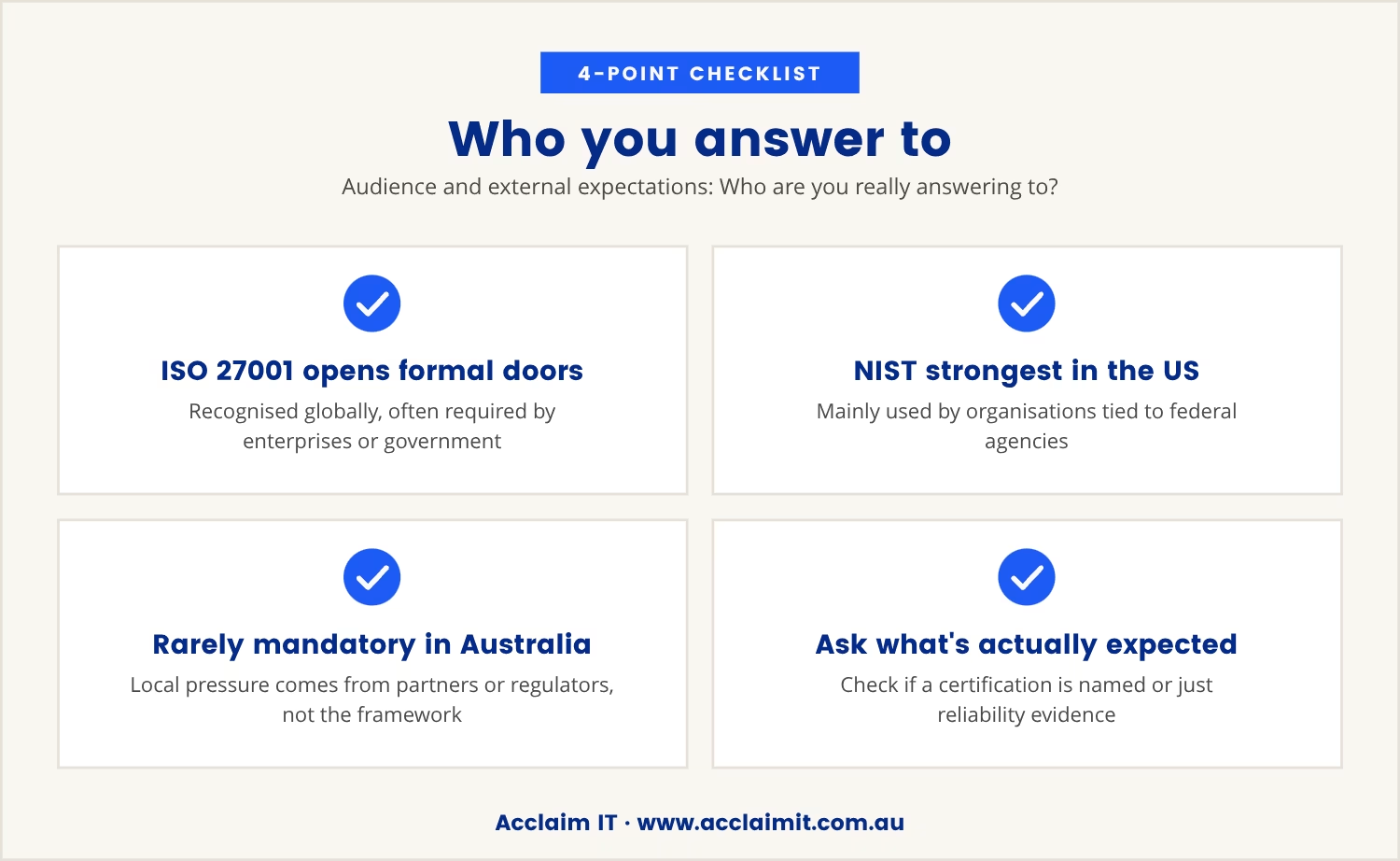
Once purpose is settled, the next fork is about audience — who the business has to satisfy. ISO 27001 carries global recognition and shows up often in requirements set by large enterprises or government contracts, so where clients or regulators expect a formal audit, ISO 27001 certification can open doors that would otherwise stay shut.
NIST, by contrast, has its strongest footing in the United States, especially among organisations working with federal agencies. Within Australia, it's respected but rarely mandatory, and for most Melbourne businesses the real pressure comes from industry partners or local regulatory expectations rather than from a framework name.
So it's worth asking directly: are customers or partners naming a specific certification, or do they just want evidence of a reliable system? The answer tends to settle the matter.
ISO 27001 vs NIST: Cost structure and hidden commitments
Cost here isn't just the consultant's invoice or the software licence — it's the standing commitment each framework locks in. ISO 27001 carries certification fees, annual audits and ongoing documentation, and those costs compound for businesses with 20 to 100 users that don't yet have a dedicated compliance team.
NIST frameworks, including the CSF, skip certification altogether, which means controls can be implemented at whatever pace and depth suits the business as it changes. There's no external audit fee to budget for, but equally no formal recognition waiting at the end.
For Melbourne businesses scaling quickly, that trade-off often becomes the deciding factor: if the badge itself is the point, ISO 27001's cost earns its keep; if not, NIST tends to offer the more sustainable path.
The five decision points that separate ISO 27001 from NIST
Beneath those broad differences sit five sharper decision points that genuinely separate the two frameworks for a growing business, and each one can redirect the path taken.
1. Purpose
ISO 27001 is built toward certification; NIST is built toward continuous improvement with no certificate at the end. That contrast shapes the compliance journey from day one.
2. Audience
ISO 27001 tends to satisfy global clients and regulators expecting formal proof, while NIST serves internal assurance and improvement unless a contract specifically demands otherwise.
3. Cost structure
ISO 27001 carries ongoing certification and audit costs, whereas NIST allows the investment to scale up or down as needs change.
4. Audit burden
ISO 27001 commits a business to regular external audits and detailed documentation; NIST relies on self-assessment, lighter in effort but less widely recognised.
5. Ongoing maintenance
ISO 27001 demands a structured cycle of reviews, updates and evidence collection, while NIST stays flexible enough to adjust controls as the business evolves.
Audit burden: What ongoing compliance really means
Opting for ISO 27001 means signing up for regular external audits that examine far more than technical controls — policies, training records and evidence of continuous improvement all come under scrutiny, and the process is thorough enough that failing it carries real business consequences.
NIST asks for none of that external checking. Controls can be assessed internally or with a partner's help, which saves time and eases pressure, though it shifts the burden onto staying disciplined about keeping the framework current without an outside check forcing the issue.
For a business without a dedicated compliance officer, ISO 27001's audit cycle can turn into a major ongoing commitment, which is exactly where NIST's lighter touch tends to be more manageable as the business grows.
Ongoing maintenance: The hidden work behind the frameworks
Compliance maintenance is never a one-off task, and ISO 27001 makes that explicit: policies, risk assessments and evidence all need continual updating, backed by a cycle of internal audits, management reviews and corrective actions. That structure catches most gaps before they widen, but it comes paired with steady paperwork and recurring reviews.
NIST, in contrast, allows controls to be updated as needed, with no fixed schedule unless one is self-imposed. That suits businesses wanting to adapt quickly, though without discipline the same flexibility can leave gaps unaddressed.
Ultimately the right fit comes down to how much structure a business genuinely needs, weighed against how much ongoing work it's prepared to carry.
When a mismatch locks you in: Risks of choosing the wrong framework
Picking a framework heavier than the business requires creates its own cost: choosing ISO 27001 purely for formality, when clients never asked for it, means paying in time and money for audits and documentation that add little real value.
The reverse carries its own risk — choosing NIST when partners expect certification can close off opportunities, leaving a business scrambling to catch up the moment a new contract demands formal proof.
Either way, the real danger is landing in a system that doesn't match the business's size or regulatory reality, which is precisely why the five decision points above are worth weighing before committing.
How to weigh your options for information security frameworks
With those risks in mind, a few practical steps can help steer clear of a costly mismatch when deciding between ISO 27001 and NIST:
- Check client and partner requirements: See if anyone in the business's network expects a specific certification or framework.
- Assess your internal resources: Consider whether there's a team in place to manage audits and documentation.
- Estimate long-term costs: Look past setup fees to the ongoing audit and maintenance expenses.
- Map your growth plans: Think about how needs might shift when user numbers grow or new markets open up.
- Review your risk appetite: Decide how much structure and external validation the business genuinely needs.
Working through these early heads off the risk of being locked into a framework that never fit in the first place.

How Acclaim IT helps you choose the right fit
If your business has 20 to 100 users, you’re likely weighing the real-world impact of ISO 27001 and NIST on your time, budget, and future growth. At Acclaim IT, we see how easy it is for teams to get locked into a framework that doesn’t fit their needs.
We invite you to see how our approach can help you make a confident, informed decision about your information security frameworks—without overcommitting to unnecessary work.
Avoid framework lock-in with waived onboarding fees
Get onboarding fees waived and a 90-day satisfaction guarantee when you start your security journey with Acclaim IT—so you can test your fit risk-free.
Frequently asked questions
What's the difference between ISO 27001 and NIST when it comes to getting certified?
ISO 27001 is a certifiable standard, meaning formal audits lead to a certificate demonstrating compliance. NIST frameworks, such as the NIST Cybersecurity Framework, are guidelines only and carry no certification, which matters wherever clients or regulators insist on documented proof.
Can I use both ISO 27001 and NIST together in my business?
Yes — plenty of businesses combine elements of both, using NIST guidelines to shape day-to-day security controls while relying on ISO 27001 for the management system and certification itself. The priority is keeping the approach practical rather than overbuilt for the business's size.
How much ongoing work does ISO 27001 require compared to NIST?
ISO 27001 calls for regular internal audits, management reviews and documentation updates, which adds up to considerable ongoing work for smaller teams. NIST frameworks allow more flexibility in how often controls are reviewed and updated, though that freedom still depends on staying disciplined to keep security strong.
Will choosing NIST over ISO 27001 limit my business opportunities in Australia?
Across Melbourne and the rest of Australia, ISO 27001 is the more commonly requested standard for formal contracts, particularly with larger organisations, while NIST remains respected but less often mandatory. Where partners or clients expect certification specifically, ISO 27001 tends to open more doors.
What is an information security management system, and do I need one?
An information security management system (ISMS) is a structured approach to managing sensitive data and security risk, and it sits at the core of what ISO 27001 builds and maintains. A formal, auditable way of managing security calls for an ISMS, though it brings a genuine ongoing workload with it.